Different Opinions, One Parenting Team: Why Children Need Parents to Stay on the Same Side.

“Dad says no. Mom says yes.”
Within seconds, a child learns something far more important than whether they can have extra screen time. They learn how power, boundaries, communication, and relationships work inside their family.
Every parent enters parenthood carrying a unique set of experiences, beliefs, and expectations. One may have grown up in a home where discipline was strict and unquestioned, while the other may have been raised with greater freedom and autonomy. These experiences naturally shape parenting styles, making differences of opinion not only common but inevitable.
The challenge is not that parents disagree. In fact, disagreements can be healthy. The challenge is what happens when those disagreements begin to shape the way children are guided, disciplined, and supported.
Research over the past two decades has consistently shown that the quality of the co-parenting relationship—the way parents work together in raising a child—plays a significant role in children’s emotional, social, and behavioural development. A recent cross-national study involving families across four countries found that stronger co-parenting relationships were associated with fewer emotional and behavioural difficulties in children, regardless of cultural differences. The findings reinforce a growing body of evidence suggesting that children benefit not from perfect parenting, but from parental cooperation and consistency.
When Differences Become Conflict
Differences in parenting are not inherently harmful. In fact, children can benefit from being exposed to different perspectives. One parent may naturally be more nurturing, while the other may encourage independence. One may focus on emotional expression, while the other prioritizes responsibility and accountability.
Problems arise when these differences evolve into visible conflict, contradiction, or competition.
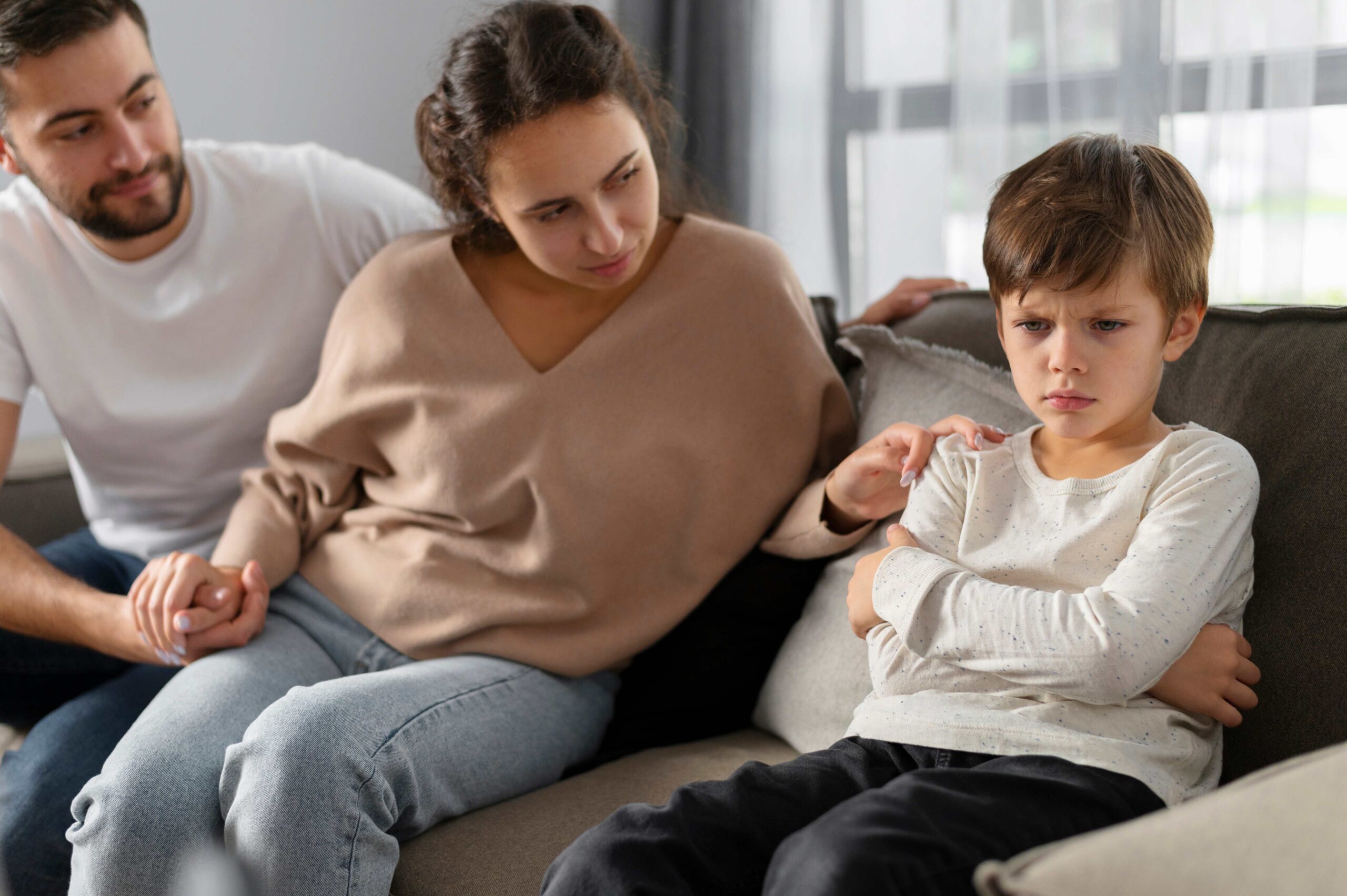
A child who hears one parent say “no” only to receive a “yes” from the other is not merely witnessing a disagreement. They are receiving conflicting information about boundaries, authority, and expectations. Over time, these mixed messages can create confusion about what rules matter, whom to listen to, and how decisions are made within the family.
Research examining childrearing disagreements found that it was not necessarily the existence of different parenting views that predicted difficulties in children, but rather the level of conflict surrounding those differences. Even after accounting for parenting quality and marital satisfaction, ongoing parental disagreement was associated with higher levels of emotional and behavioural problems in children.
In other words, children are often affected less by the disagreement itself and more by the tension that accompanies it.
What Children See When Parents Are Not United
Parents often assume their disagreements remain between adults. Children, however, are remarkably observant.
Long before they understand the details of an argument, they notice the sigh after a decision, the dismissive tone, the eye roll, the correction, or the frustration directed toward the other parent. They pay attention to who is supported, who is challenged, and who appears to hold the final authority.
When parents regularly undermine one another, children may begin to question the legitimacy of family rules altogether. Some learn to seek out the answer they prefer from the more permissive parent. Others become anxious, uncertain about which expectations apply and when. Younger children may even believe they are the cause of the conflict, carrying emotional burdens they are not equipped to manage.
Studies examining co-parenting quality have repeatedly found that children experience the most positive social and emotional outcomes when parents present a consistent and supportive parenting partnership. A large study involving nearly 3,000 families found that children fared best when both parents viewed their co-parenting relationship positively and demonstrated alignment in their approach to raising their child.
The message children receive is subtle but powerful. When parents consistently support one another, children feel secure. When parents openly undermine one another, children often experience uncertainty about both family rules and family relationships.
The Hidden Impact on the Parents’ Relationship
Parenting disagreements rarely remain confined to parenting.
What begins as a discussion about bedtime, screen time, homework, or discipline can gradually become a question of trust, respect, and partnership. When one parent feels repeatedly overruled or criticised in front of the child, resentment often follows. The disagreement stops being about the child’s behaviour and starts becoming about whether each parent feels valued and supported.
Researchers describe this as a “spillover effect,” where tension in the parental relationship influences parenting behaviour, and parenting conflict further strains the relationship. Studies have shown that destructive interparental conflict can increase parenting stress and contribute to less supportive parenting practices over time.
This creates a cycle that can be difficult to break. The more unsupported parents feel, the harder it becomes to function as a team. The less they function as a team, the more disagreements emerge.
Ironically, many parenting disagreements begin because both parents care deeply about their child. Yet when those disagreements are not handled constructively, they can weaken the very partnership that children rely on most.
Why Unity Does Not Mean Uniformity
One of the biggest misconceptions about parenting is that successful parents must agree on everything.
In reality, complete agreement is neither realistic nor necessary.
Healthy co-parenting is not about having identical parenting styles. It is about sharing core values and presenting a united front on important decisions. Children can thrive with parents who approach situations differently, provided those differences are expressed respectfully and do not undermine the family’s overall structure.
The distinction is important. A child can understand that one parent is naturally more patient while the other is more structured. What becomes difficult for children is when parents openly challenge each other’s authority or communicate conflicting expectations.
Unity is not the absence of differences. It is the ability to manage those differences in a way that protects both the child and the relationship.
Navigating Parenting Differences Constructively
Every parenting partnership will encounter moments of disagreement. The goal is not to eliminate these moments but to handle them in ways that strengthen rather than weaken the family.
Research on effective co-parenting consistently highlights the importance of communication, support, and mutual respect. Parents who discuss disagreements privately, remain focused on shared goals, and avoid criticising one another in front of their children are more likely to maintain a healthy co-parenting alliance.
This often requires shifting the conversation away from who is right and toward what the child needs. In many cases, parents discover they share the same objective—raising a responsible, confident, emotionally healthy child—but differ only in their methods.
Successful co-parenting is not about winning arguments. It is about remembering that both parents are on the same side, even when they approach challenges differently.
When the focus remains on the child’s long-term well-being rather than proving a point, compromise becomes easier and cooperation more natural.
The Message Children Carry Into Adulthood
Perhaps the most important reason for parental unity extends beyond childhood itself.
Children learn how relationships work by watching the relationships closest to them. They learn how people handle disagreements, express respect, negotiate differences, and resolve conflict. Every interaction between parents becomes a lesson in communication, problem-solving, and emotional regulation.
When parents consistently undermine one another, children may come to view conflict as a competition that produces winners and losers. When parents disagree respectfully, listen to each other, and ultimately work together, children learn that strong relationships can accommodate differences without falling apart. They learn that disagreements do not have to threaten connection and that respect can coexist with differing viewpoints.
The lesson children absorb is not that families never disagree. It is that families remain connected despite disagreement. In a world where differences of opinion are inevitable, that may be one of the most valuable lessons parents can teach.
Children will not remember every rule their parents set, every consequence they enforced, or every decision they made. But they will remember the environment in which those decisions were made. They will remember whether the adults who raised them treated each other with respect, supported one another through challenges, and worked together even when they saw things differently.
In the end, children do not need parents who agree on everything. They need parents who can navigate their differences without creating division. Because long after childhood is over, children may forget many of the rules they grew up with—but they will remember whether the adults who raised them worked against each other or worked together.